
Platform
One platform carrying the plan through to impact
Not four modules side by side but one chain: the objective knows its KPI, the KPI knows its project, and the project knows the evidence that proves its readiness.
Four layers, and a link held between them
Every item in the platform carries its place in the chain: the initiative knows its objective, the KPI knows its target, baseline and data source, the project knows the KPI that justifies it, and the condition knows the evidence that satisfies it. When a link breaks, the platform sees it and shows it, instead of letting it vanish into a spreadsheet.
Strategy
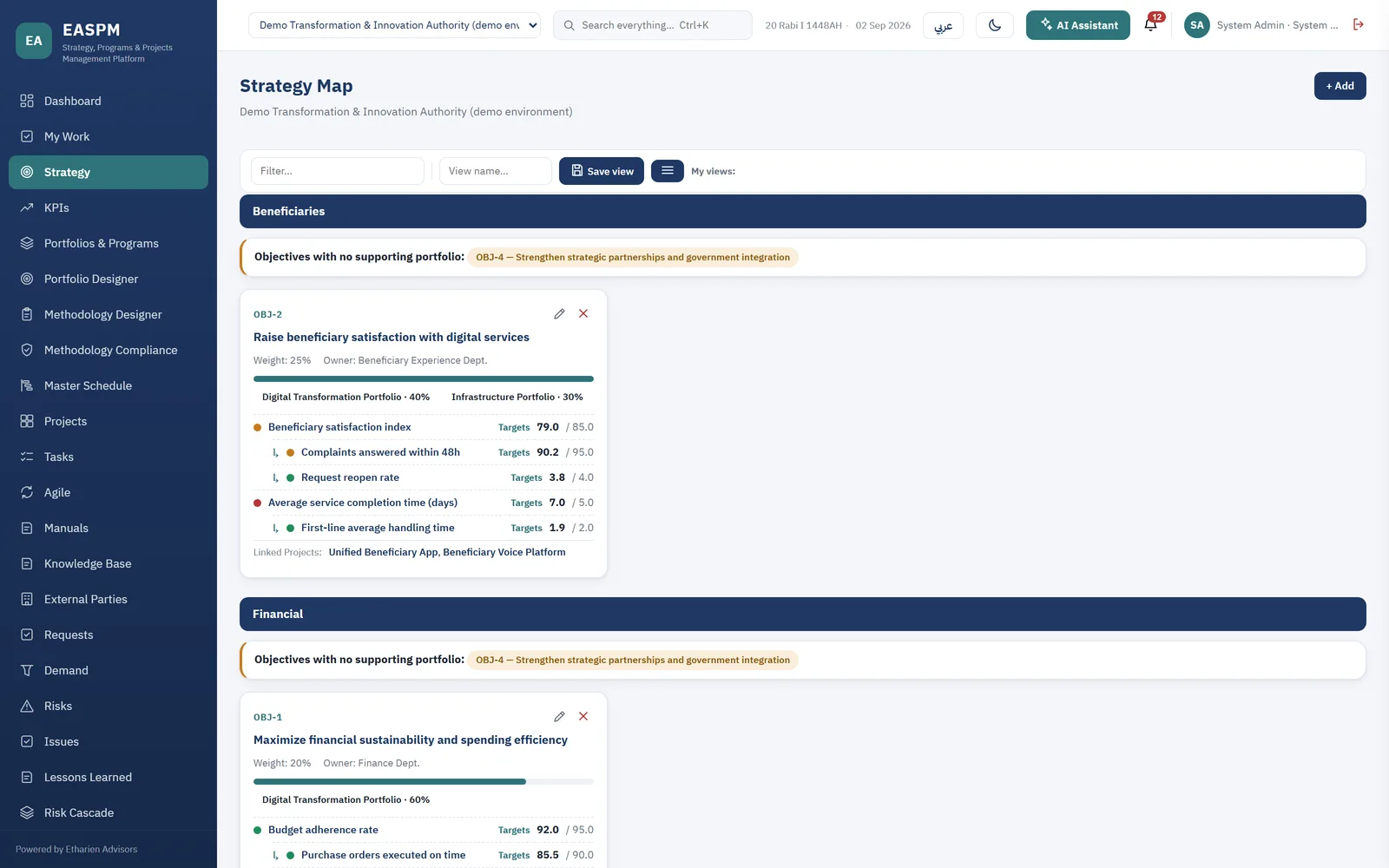
The strategic plan is built inside the platform rather than imported as a picture. Every objective has an owner, a measure, initiatives, and a clear position on the map. A methodology designer configures the planning method the entity already uses rather than imposing another.
- Strategy map
- Visual representation of objectives and the cause-and-effect relationships between them, navigable.
- Objective cascade
- Cascade the corporate objective to sectors and departments without losing the link.
- Initiatives
- Each initiative tied to the objective it serves, with owner and timeframe.
- Alignment
- Connect the plan to national reference frameworks and the entity's approved plans.
- Approval and versions
- Plan versions preserved across cycles with a full change history.
Performance
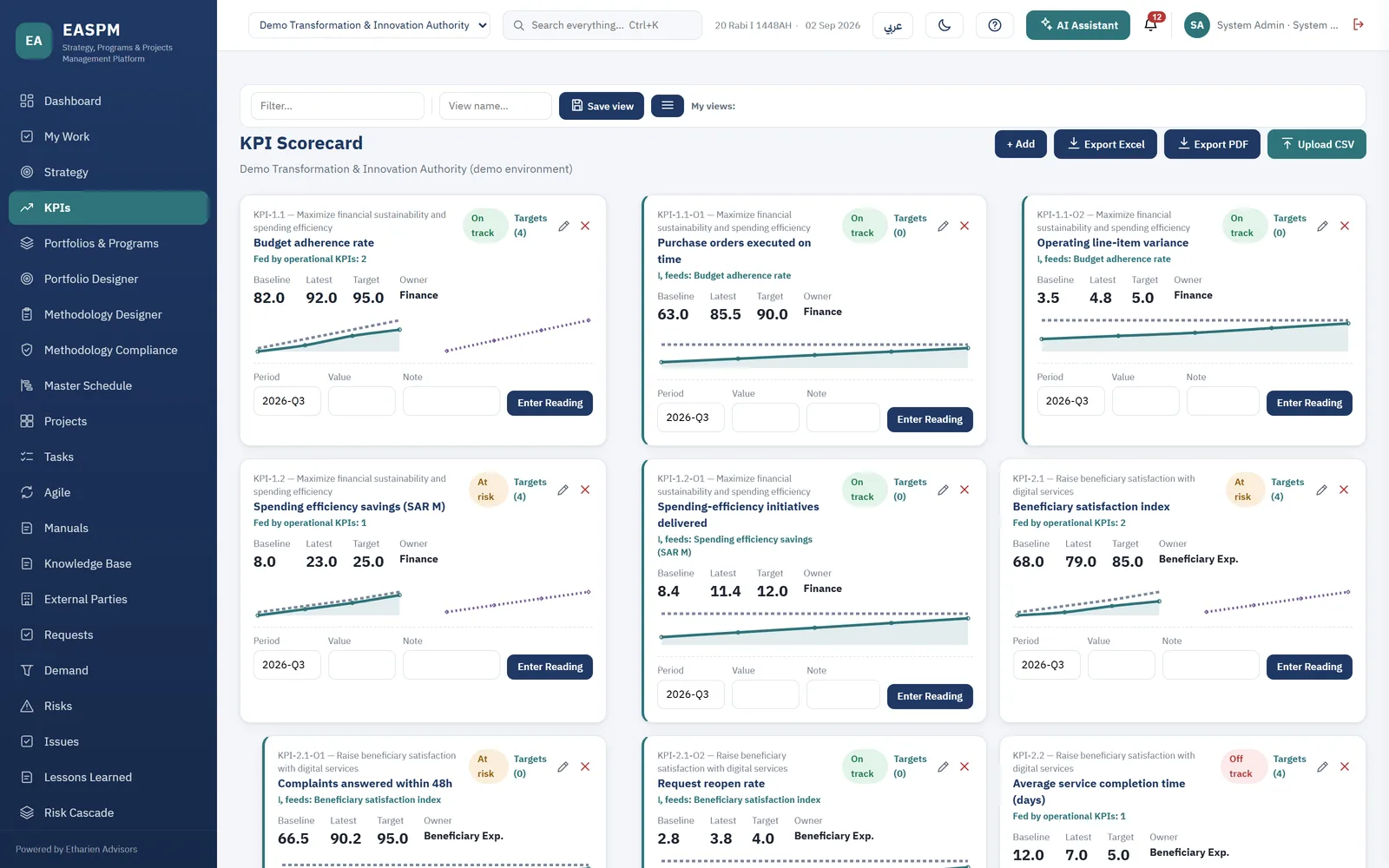
Performance management treated as a recurring cycle with dates, owners and accountability, not a dashboard refreshed on request. KPIs cascade from the corporate level to sectors, and every KPI keeps its history across cycles.
- KPI definitions
- Measure, formula, frequency, data source and owner, all defined once per KPI.
- Targets and baselines
- Target, actual and variance across periods with historical comparison.
- Scorecards
- A scorecard per organisational level, aligned to the entity's own methodology.
- Monitoring cycles
- Scheduled entry, review and approval, with overdue alerts.
- Executive reporting
- Leadership-ready reports generated from the same data, not reassembled from it.
Portfolios, Programs & Projects
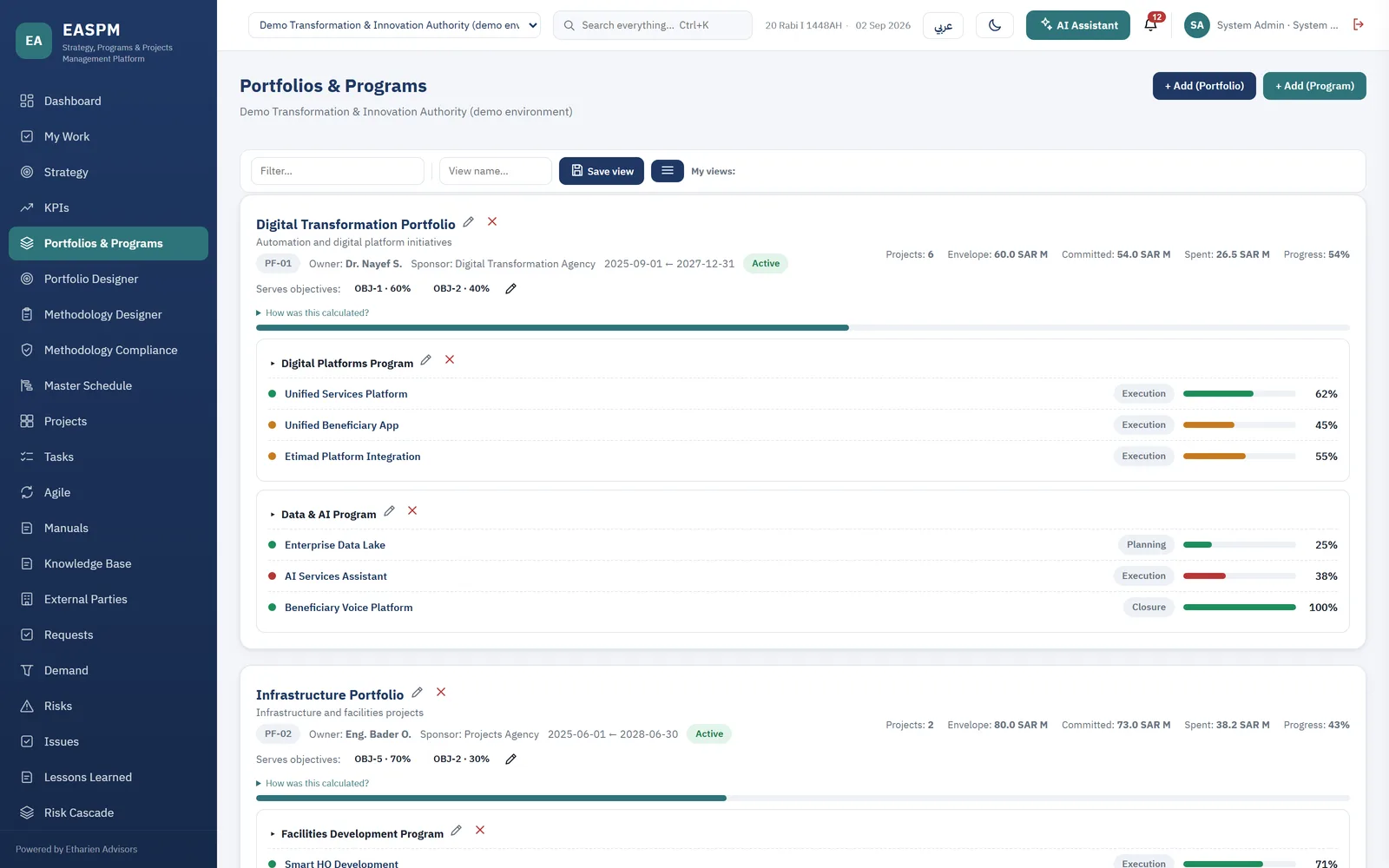
The delivery layer. Every project is tied to the KPI and objective that justify it, and slippage surfaces upward to leadership. Projects run on the methodology the entity adopts, predictive or agile, and stakeholders and external parties follow them through a portal of their own.
- Portfolio governance
- Portfolio classification, entry and prioritisation criteria, budget allocation.
- Program management
- Group related projects and measure benefits at program level.
- Projects and milestones
- Schedule, key milestones, deliverables and completion, with a master schedule across the portfolio.
- Risks and issues
- A single register with owner, response plan, and impact on the objective.
- Resources and cost
- Resource allocation and spend tracked against approved budget, with earned value.
Readiness and maturity
The frameworks an entity is measured against are represented as conditions, evidence and owners, not a file assembled two weeks before the deadline. The platform displays no predicted score, no predicted ranking, and claims no accreditation from any assessment body. Frameworks and readiness.
- Conditions register
- Every requirement in the framework, its owner, and its current state.
- Evidence vault
- Evidence linked directly to the condition it satisfies, with date and source.
- Gap analysis
- What is met, what lacks evidence, and what has not started.
- Multiple frameworks
- More than one framework over the same data, without duplicate entry.
- Your own frameworks
- Configure an internal framework or proprietary methodology with your own criteria and weights.

What makes four layers one system
- Roles and permissions
- Row-level and field-level permissions, per-entity isolation, and a way to review what each role sees.
- Approval workflows
- A no-code workflow designer: who enters, who reviews, who approves, and in what order.
- Forms and fields
- A form designer adds the entity's own fields without changing the system.
- Alerts
- Notifications on delays, breaches and approaching dates, by email and in the platform.
- Audit logs
- A complete record of every change: who, when, and what it was before and after.
- Reports and export
- Executive report templates, and export to PDF and Excel in Arabic and English.
- Assistant
- An assistant that answers questions about the entity's data within the user's permissions and shows the source of every answer.
- Integration
- APIs for connection to HR, finance, the entity's directory and other source systems.
Technology and hosting
The platform is hosted in the Kingdom, designed with NCA and SDAIA requirements in consideration.
A separate environment per entity, single sign-on connected to the entity's directory, data encrypted in transit and at rest, and regular backups with published recovery objectives. Security and hosting.
See the chain working on data from your sector
A demonstration on a scenario from your domain, followed by an open discussion of what fits and what does not.